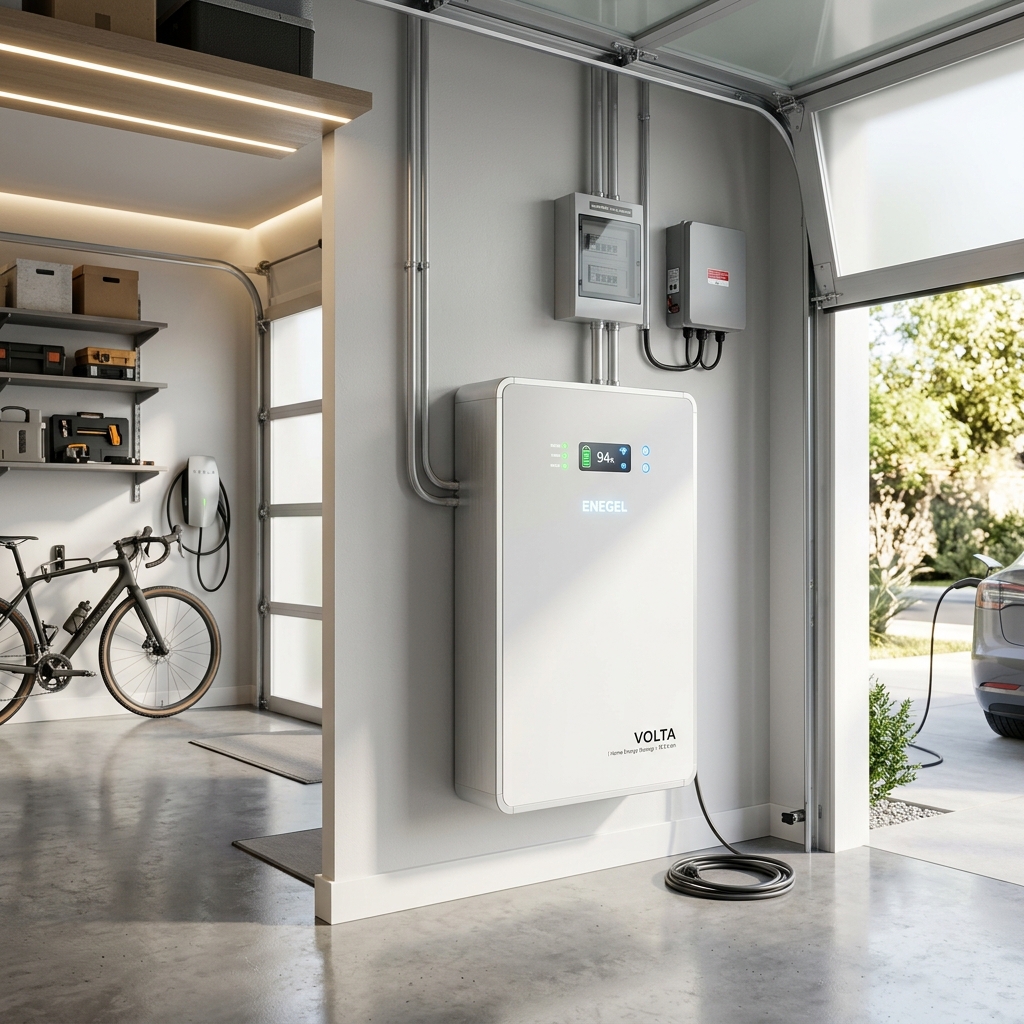
The Global Shift: USA, Europe, UK, and Asia
The global transition to solar energy is accelerating. In the USA and UK, rising grid costs and winter storms drive demand for resilient home storage. In Europe, the push for green independence has spurred massive battery subsidies. Meanwhile, across Asia, rolling blackouts and rapid solar adoption have created explosive demand for efficient, space-saving battery systems.

Regardless of your continent, the core mathematical challenge remains the same: balancing the high initial capital of modern storage against the long-term savings.
Depth of Discharge (DoD): The Hidden Cost multiplier
When calculating battery needs, Depth of Discharge (DoD) is the most critical metric. DoD is the percentage of the battery you can use without damaging it.
- Lead-Acid (Tubular / AGM): Max 50% DoD. If you buy a 10kWh lead-acid bank, you can only safely use 5kWh.
- Lithium (LiFePO4): 80% to 95% DoD. A 10kWh lithium bank gives you 8.5kWh to 9.5kWh of usable energy.
Lifespan (Cycles) vs. Upfront Cost
A "cycle" is one full discharge and recharge. Lead-acid batteries typically last 500 to 1,000 cycles (about 3 to 5 years of daily use). Lithium batteries, specifically Lithium Iron Phosphate (LiFePO4), easily reach 4,000 to 6,000 cycles (10 to 15+ years).
| Feature | Lead-Acid | Lithium (LiFePO4) |
|---|---|---|
| Usable Capacity (DoD) | 50% | 80% - 95% |
| Cycle Life | 500 - 1,000 cycles | 4,000 - 6,000 cycles |
| Maintenance | Requires water top-ups | Zero maintenance |
| 10-Year Cost | High (Need 2-3 replacements) | Low (No replacements) |
Real-World Financial Breakdown (10kWh Usable System)
Let's look at the actual numbers over a 10-year period. To get 10kWh of usable energy, you need a 20kWh Lead-Acid bank (due to 50% DoD) or roughly an 11kWh Lithium bank (due to 90% DoD).
| Financial Metric | Lead-Acid System | Lithium (LiFePO4) System |
|---|---|---|
| Total Capacity Needed | 20 kWh | 11 kWh |
| Estimated Upfront Cost | $2,500 | $3,500 |
| Replacements in 10 Years | 2 times | 0 times |
| Total 10-Year Cost | $7,500 | $3,500 (Winner) |
Live Appliance & Battery Sizing Tool
Don't guess what size battery bank you need. Enter your appliances, select Lithium or Lead-Acid under the battery settings, and instantly see the difference in required capacity and cost below!
Quick Add Appliances
Configure Load Details
No appliances added yet
Click items in the grid above to add them to your solar estimation plan.
Battery Backup (Off-Grid / Hybrid)
Store excess solar energy for use during night-time or power outages.
Energy Consumption & Generation Overview
Daily Load Breakdown
Add appliances to view load breakdown chart.
How to Use the Solar Calculator
Follow these three steps to accurately size your solar power system for home or business use.
Calculate Total Consumption
Before purchasing solar panels, you must know your actual daily consumption in kilowatt-hours (kWh). Our solar panel calculator allows you to input exact quantities, power ratings (Watts), and daily operating hours for fans, LED lights, air conditioners, and kitchen appliances.
(Watts × Qty × Hours) ÷ 1000 = kWh per dayGrouping appliances gives your total daily and monthly utility footprint.
Recommended Solar System Size
System size in kW depends on average daily sun hours and efficiency losses. Average global locations receive between 4.0 to 6.0 peak sun hours per day. We assume a standard 5.0 peak sun hours with an 80% system efficiency factor.
Daily kWh ÷ (Peak Sun Hours × 0.8) = Solar kW SizeWe automatically round up to align with whole numbers of modern 550W modules.
Select Inverter & Batteries
Inverters convert DC solar panel power to AC home power. We apply a 20% safety headroom above the system size. For energy storage, we calculate backup requirements during night-time or power outages based on your backup hours target.
Lithium: 85% DoD • Lead-Acid: 50% DoDLead-acid batteries must align with series voltage connection multiples (4× for 48V systems).