Power Your EV With Solar: The Complete Home Energy Setup Guide
Published: June 5, 2026 · 11 min read · UK, USA & Europe
Owning an EV is the first step. Owning an EV charged entirely by your own rooftop solar is where running costs genuinely approach zero. Here is exactly how to build that setup.
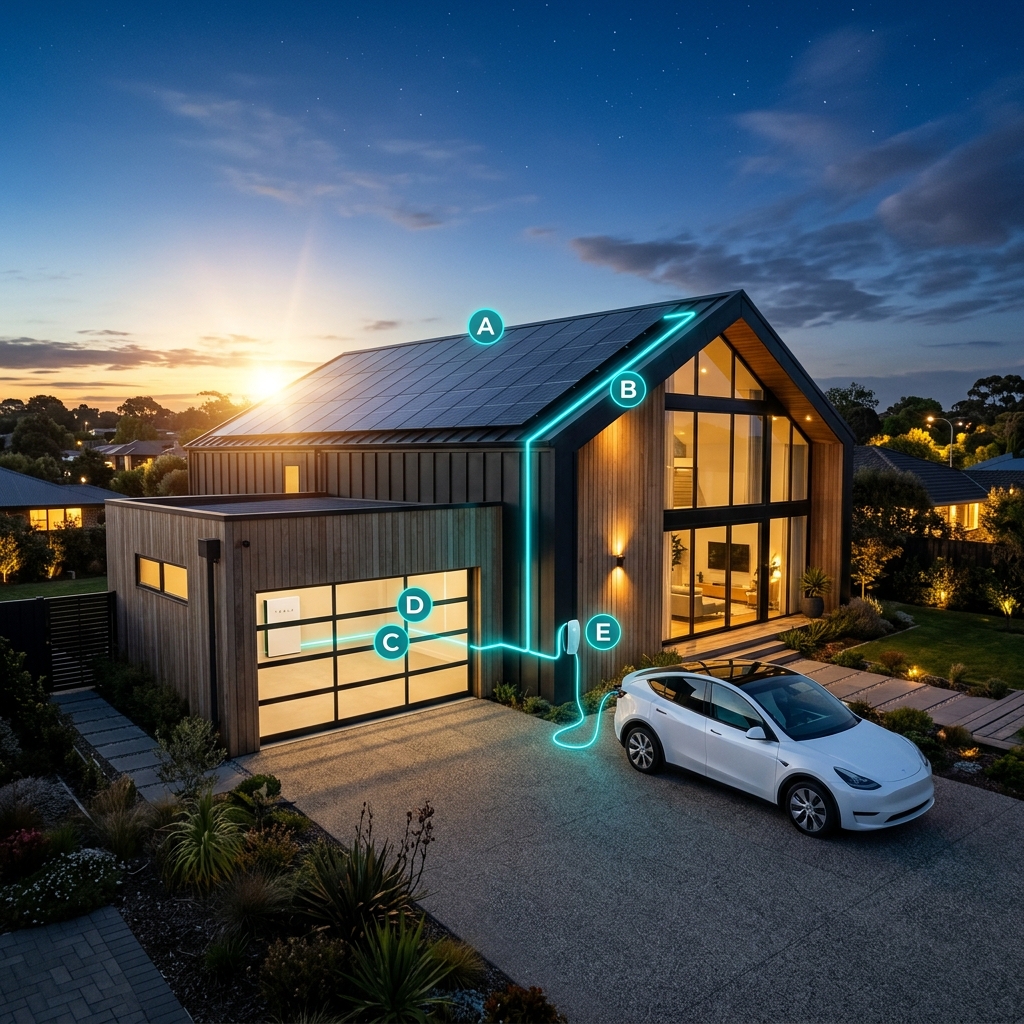
Why This Combination Is So Powerful
An electric vehicle and a solar system are individually smart investments. Together, they form something better than the sum of their parts. Your EV becomes a large, flexible load that can absorb excess solar generation precisely when your panels are producing more than your home needs. Your solar system gains a purpose beyond feeding the grid at reduced export rates.
The result: drivers in the UK, USA, and Europe with this setup consistently report charging costs dropping to near zero in summer months, with year-round average costs that are 70–85% lower than grid electricity alone.
This is not a niche setup for tech enthusiasts anymore. In 2025, smart EV chargers that communicate directly with solar inverters are widely available from mainstream manufacturers. The installation process is well-understood and the payback period for the combined system is often shorter than for either technology alone.
How the System Works
A solar-to-EV charging system has four core components. Understanding each one helps you make the right decisions when speccing your setup.
1. Solar Array
Your panels generate DC power from sunlight. A 4kW system (10 panels) generates 3,400–4,800 kWh annually in the UK, or 5,000–6,500 kWh in sunny US states — enough to cover both household use and a significant portion of EV charging.
2. Hybrid Inverter
A hybrid inverter converts solar DC to household AC while simultaneously managing battery storage and grid export. It is the brain of your system and enables smart coordination between panels, battery, home, and EV charger.
3. Battery Storage
A 10kWh battery stores midday excess generation for evening EV charging. Without a battery, you rely on simultaneous generation and charging, which works well if you commute during daylight hours — or not at all if you work standard office hours.
4. Smart EV Charger
A solar-aware smart charger monitors real-time generation and only draws power from the grid as a last resort. Leading brands in 2025 include Ohme, Zappi, and Wallbox — all of which integrate with major inverter brands via APIs or direct communication protocols.
How Many Solar Panels Do You Need to Charge an EV?
This is the most-searched question about solar-EV integration, and the answer depends on your driving habits. The average UK driver covers 7,500 miles per year. The average European covers around 10,000 miles. A typical EV uses 3–4 miles per kWh, meaning:
| Annual Mileage | EV Electricity Needed | Extra Panels Required | Combined System Size |
|---|---|---|---|
| 7,500 miles (UK avg) | ~2,100 kWh | 5–6 panels | ~6kW total |
| 10,000 miles | ~2,800 kWh | 7–8 panels | ~7kW total |
| 15,000 miles | ~4,200 kWh | 10–12 panels | ~9kW total |
| 20,000 miles (high mileage) | ~5,600 kWh | 13–16 panels | ~11kW total |
These figures assume UK/Northern Europe solar irradiance. In the US Sun Belt (Texas, California, Arizona), you would need 20–25% fewer panels to generate the same energy. In Germany or the Netherlands, add 10–15% to the panel count.
The Real-World Savings: A Worked Example
Here is a concrete scenario for a UK homeowner. Family of four. Annual electricity bill of £1,600. Annual driving mileage of 10,000 in a mid-range EV. Currently charging from the grid at standard tariff.
The combined solar-EV system does not just pay for itself. It effectively locks in your energy and fuel costs for 25 years, immune to grid price rises, geopolitical energy shocks, and fuel tax increases. That energy security is worth something beyond the spreadsheet.
Smart Charging Strategy: Getting the Most From Your Setup
The single most important thing you can do after installing a solar-EV system is configure your charger to follow solar generation rather than charge on a schedule. Modern smart chargers allow you to set a minimum import threshold — for example, only begin charging when the house has 1.4kW of surplus solar, and ramp up as generation increases.
In practice this means parking when you arrive home, plugging in, and letting the system do its work throughout the day. On a clear summer day in the UK, a 6kW system can deliver 30–35 kWh — enough to add 105–120 miles of range to your car, for free, before the evening.
For winter months, the strategy shifts. Set your smart charger to top up from the grid on an off-peak overnight tariff — rates as low as 7p/kWh in the UK and $0.06/kWh in the US — and treat solar as a bonus rather than the primary source.
Planning Your Installation: Where to Start
The most practical starting point is to calculate your actual numbers before speaking to any installer. Know your monthly kWh consumption, your annual mileage, and the orientation of your main roof. With those three figures, you can size your system accurately and walk into any installer conversation knowing exactly what you need.
Get at least three quotes. Prices for equivalent systems can vary 20–30% between installers. Check that any installer in the UK is MCS-certified (required for Ofgem Smart Export Guarantee eligibility). In the US, verify NABCEP certification for installers claiming system performance guarantees.
Step 1: Calculate Your Solar Panel Needs
Use our interactive calculator to find out exactly how many panels you need to cover your home and EV charging.
Quick Add Appliances
Configure Load Details
No appliances added yet
Click items in the grid above to add them to your solar estimation plan.
Battery Backup (Off-Grid / Hybrid)
Store excess solar energy for use during night-time or power outages.
Energy Consumption & Generation Overview
Daily Load Breakdown
Add appliances to view load breakdown chart.
How to Use the Solar Calculator
Follow these three steps to accurately size your solar power system for home or business use.
Calculate Total Consumption
Before purchasing solar panels, you must know your actual daily consumption in kilowatt-hours (kWh). Our solar panel calculator allows you to input exact quantities, power ratings (Watts), and daily operating hours for fans, LED lights, air conditioners, and kitchen appliances.
(Watts × Qty × Hours) ÷ 1000 = kWh per dayGrouping appliances gives your total daily and monthly utility footprint.
Recommended Solar System Size
System size in kW depends on average daily sun hours and efficiency losses. Average global locations receive between 4.0 to 6.0 peak sun hours per day. We assume a standard 5.0 peak sun hours with an 80% system efficiency factor.
Daily kWh ÷ (Peak Sun Hours × 0.8) = Solar kW SizeWe automatically round up to align with whole numbers of modern 550W modules.
Select Inverter & Batteries
Inverters convert DC solar panel power to AC home power. We apply a 20% safety headroom above the system size. For energy storage, we calculate backup requirements during night-time or power outages based on your backup hours target.
Lithium: 85% DoD • Lead-Acid: 50% DoDLead-acid batteries must align with series voltage connection multiples (4× for 48V systems).
Solar Sizing Frequently Asked Questions
Step 2: Calculate Your EV Savings
See how much you'll save on fuel by charging with your new solar setup.
📍 Quick-select your region
🚗 Driving & Fuel Variables
💡 Tip: Average US electricity rate is ~$0.15/kWh. A typical EV gets ~3.5 mi/kWh. Gas averages ~25 MPG nationally.
⚡ Popular EV Models — click to auto-fill
Your Estimated Savings
Yearly Fuel Savings
Money kept in your pocket every year.
Monthly Gas
$170
Monthly EV
$52
Monthly Savings
$118
📊 5-Year Cost Comparison
🌱 CO₂ Saved Per Year
3,496 kg
≈ 166 trees worth of carbon/year