Vehicle-to-Grid (V2G): How Your EV Could Pay Your Electricity Bill in the UK & Europe
Published: June 13, 2026 · 10 min read · UK & Europe Focus
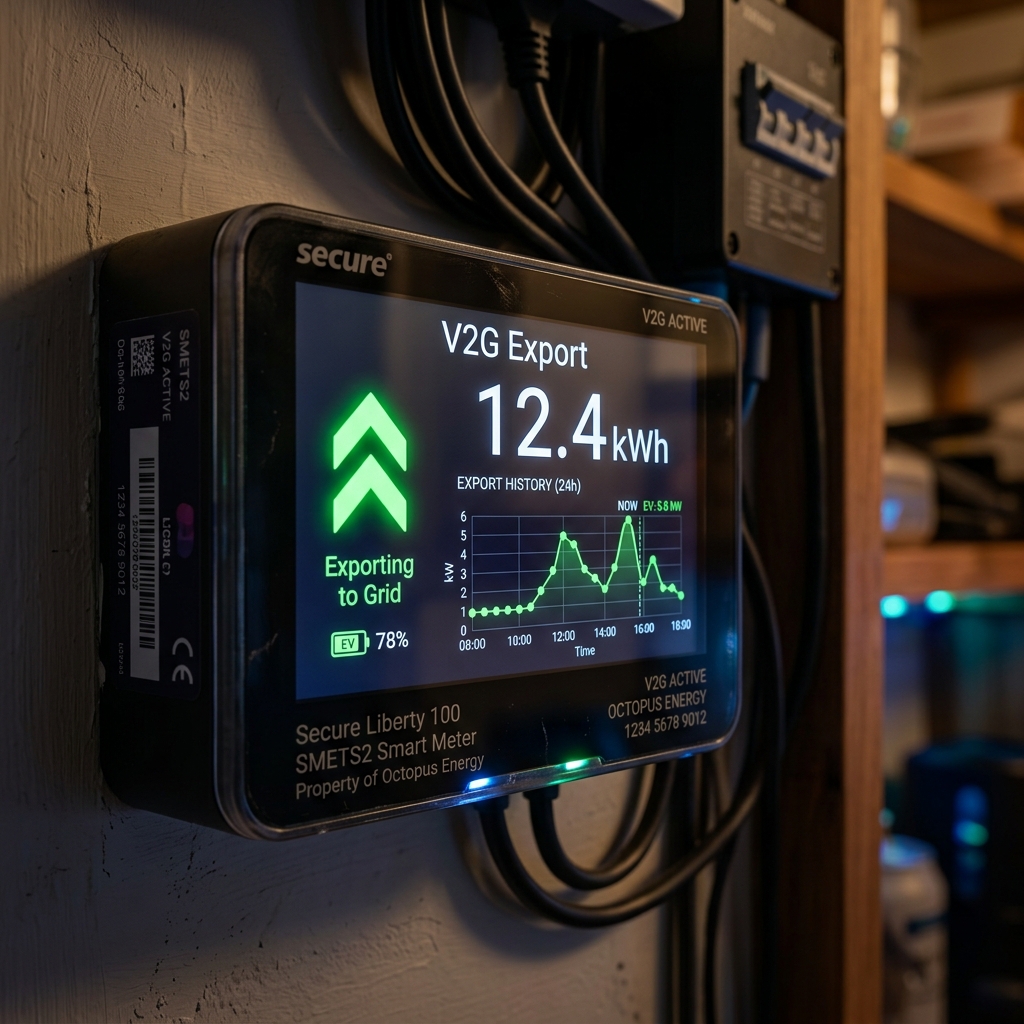
Your electric car spends 95% of its time parked. Vehicle-to-Grid technology means those parked hours could earn you hundreds of pounds or euros a year — by turning your car's battery into a mini power station for the grid.

What Is Vehicle-to-Grid and Why Is 2026 the Breakthrough Year?
Vehicle-to-Grid (V2G) is a bidirectional charging technology that allows electricity to flow not just into your EV battery, but also back out — into your home or onto the national grid. In 2026, it has crossed from experimental pilot to genuine mainstream product across the UK, Netherlands, Germany, and Ireland.
The shift happened for three reasons simultaneously: grid operators in the UK and Germany started paying meaningful rates for flexibility services; the cost of bidirectional chargers (also called V2G or V2H chargers) fell below £1,000; and a critical mass of compatible vehicles arrived on UK roads — most notably the Nissan Leaf, Mitsubishi Outlander PHEV, Volkswagen ID. range, and Hyundai Ioniq 5 and 6.
In the UK, Octopus Energy's "Power-Up" and "Power-Down" sessions — where the grid pays EV owners to charge or discharge at specific times — are now open to tens of thousands of households. National Grid ESO openly states that V2G from EV fleets could provide up to 7 GW of grid flexibility by 2030, equivalent to seven large gas-fired power stations.
How Much Can You Earn? Country-by-Country Breakdown
Earnings vary depending on your country's grid flexibility market, your energy tariff, how much you drive, and how often you are plugged in. Here is the current landscape:
| Region | V2G Programme | Est. Annual Earnings | Compatible Charger Cost | Status |
|---|---|---|---|---|
| 🇬🇧 United Kingdom | Octopus Power-Up/Down, OVO V2G | £500–£1,200/yr | £800–£1,400 | Commercially live |
| 🇩🇪 Germany | Bundesnetzagentur Flexibility | €400–€900/yr | €900–€1,600 | Pilot → Rollout |
| 🇳🇱 Netherlands | Jedlix / Eneco V2G | €600–€1,100/yr | €800–€1,200 | Commercially live |
| 🇮🇪 Ireland | EirGrid SmartCharge | €350–€700/yr | €900–€1,500 | Expanding |
| 🇫🇷 France | EDF Pulse & You | €300–€600/yr | €1,000–€1,800 | Early stage |
Key insight: A UK household with a 77 kWh EV battery, a V2G charger, and an Octopus Go tariff can earn up to £1,200/year — enough to cover the entire annual cost of charging the car itself, effectively making driving free.
Which Cars Are V2G Compatible in 2026?
Not all EVs support bidirectional charging. The technology requires CHAdeMO or specific CCS2 implementations that allow reverse power flow. In 2026, the main compatible vehicles available in the UK and Europe include:
- Nissan Leaf (2nd gen, 2018–present) — CHAdeMO, excellent V2G support via Nissan Energy Solar
- Mitsubishi Outlander PHEV — CHAdeMO, widely used in UK V2G pilots
- Volkswagen ID.3 / ID.4 / ID.7 (2024+ firmware) — Bidirectional CCS2 via software update
- Hyundai Ioniq 5 & 6 — V2L (Vehicle-to-Load) and V2H capable; V2G via third-party chargers
- Kia EV6 — V2L standard, V2G via compatible charger
- BYD Seal & Atto 3 — Bidirectional CCS2, rapidly growing UK presence
By the end of 2026, all new mainstream EV models sold in the EU are expected to support bidirectional charging under the EU's revised Alternative Fuels Infrastructure Regulation (AFIR). This effectively mandates V2G readiness across the European market.
Does V2G Damage Your EV Battery?
This is the single most common concern, and the honest answer is: minimally, if managed correctly. Battery degradation is caused primarily by extreme temperatures and charging to 100% or depleting to 0% regularly. V2G programmes are designed to operate within a 20%–80% state-of-charge window.
Studies from Nissan's V2G pilots in the UK (run with OVO Energy) found less than 1% additional degradation over 12 months compared to standard charging. Octopus Energy's trials reached similar conclusions. Manufacturers including Volkswagen, Hyundai, and Nissan are now offering battery warranties that explicitly cover V2G use — a major shift from even 2024.
V2H vs V2G: Which Is Better for UK & European Homeowners?
V2H (Vehicle-to-Home) is a simpler version of the technology — it powers your home from the car's battery during peak hours or outages, without exporting to the grid. V2H does not require grid operator registration and can be installed by any MCS-certified electrician.
The financial case: in the UK, buying grid electricity at peak (28p/kWh) and instead using stored cheap overnight electricity (7p/kWh via Agile Octopus) to run your home during the 4pm–7pm peak saves approximately £400–£700 per year — without any export payment at all.
Calculate Your EV Savings
Use our free EV savings calculator to estimate how much you could save (or earn) with smart charging and V2G — tailored to your mileage and electricity tariff.
📍 Quick-select your region
🚗 Driving & Fuel Variables
⚙️ Advanced Efficiency Settings
💡 Tip: Average US electricity rate is ~$0.15/kWh. A typical EV gets ~3.5 mi/kWh. Gas averages ~25 MPG nationally.
⚡ Popular EV Models — click to auto-fill
Your Estimated Savings
Yearly Fuel Savings
☕ That's enough to buy ~354 cups of coffee!
Monthly Gas
$170
Monthly EV
$52
Monthly Savings
$118
📊 5-Year Cost Comparison
🌱 CO₂ Saved Per Year
3,496 kg
≈ 166 trees worth of carbon/year